How Early Films Turned the Seaside Excursion Into a Story
Explore how early seaside films used crowds, bathing, and amusement to make the outing itself shape character, comedy, and social tension on screen.
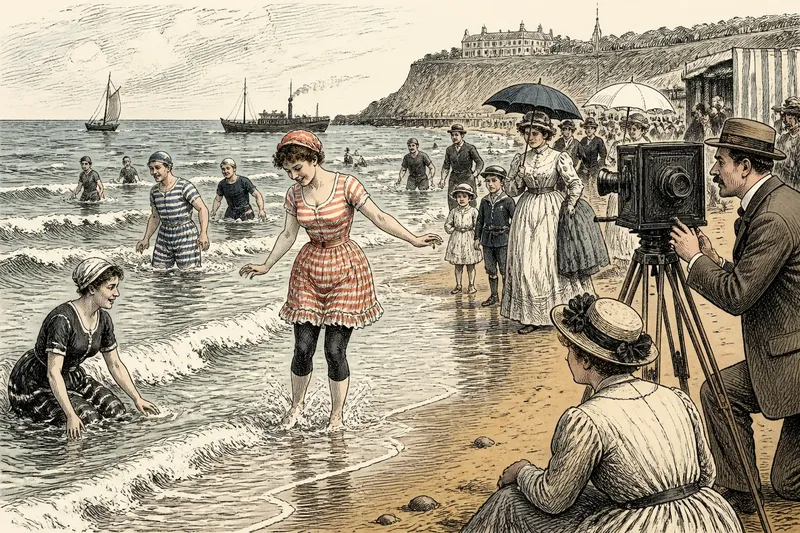
The seaside excursion gave early filmmakers action they could show without relying on dialogue: crowds arriving, bathers testing the water, and holidaymakers posing for the camera. In films such as Rough Sea at Dover (1896), the coast could be the spectacle itself; later seaside comedies used the same public setting to stage mishaps and encounters. The shift was not a single leap from scenery to story, but a growing opportunity to make leisure visible.
Why did early filmmakers point cameras at the shore?
In the 1890s, many films were brief views of people, places, and events rather than elaborate plotted dramas. The sea offered movement in nearly every part of the frame: waves break, boats pass, and visitors cross the beach. Birt Acres’s Rough Sea at Dover, made in 1896, is a useful example of the coast as a moving attraction. Its interest lies in the action of the water, not in a developed story about holidaymakers.
Other early films made the visitors’ behavior the event. The Lumière catalogue includes Baignade en mer (1895), commonly known in English as Sea Bathing, which shows people entering the water. The simple action gives viewers a clear subject: bodies approach, plunge, and react to the sea. The film does not need to invent a complicated plot to make the outing watchable.
These examples suggest a useful distinction, not a rigid timeline. Some coastal films presented a view or a public activity; others used the shore to set up comic business. Their short forms and varied purposes resist a neat story of cinema steadily discovering narrative. What the seaside reliably supplied was motion, recognizable recreation, and a public space where behavior could be observed.
How did seaside comedies turn recreation into action?
British filmmaker James Williamson made The Big Swallow (1901), a comic trick film in which a man approaches the camera and appears to swallow it. It is not a seaside outing, but it shows how early filmmakers could turn a direct encounter with the camera into a gag. Coastal comedies could use comparable visual simplicity: a visitor slips, a bathing costume causes embarrassment, or a crowd reacts to an unexpected mishap. The shoreline made such business legible because the activity and its setting were familiar.
For a specifically seaside example, The Sea Cave (1907), directed by Edwin S. Porter, uses a coastal setting for a short dramatic action rather than treating the water as a mere view. Its period belongs to a time when filmmakers were experimenting with more developed staged action, though the change varied by country, producer, and genre. The point is not that every film followed the same path, but that a recognizable place could help audiences follow action quickly.
A beach also put characters in public. A performer’s attempt to look composed could be undone by wet sand, a gust of wind, or the attention of strangers. This creates a specific kind of comedy: the gap between the behavior a visitor intends and the behavior other people witness. The shore’s crowds and practical inconveniences can drive the scene, rather than merely decorate it.
What did a seaside outing let films show?
A visit to the coast has a built-in sequence: leaving familiar surroundings, arriving somewhere different, spending time there, then facing the return. A short film might suggest that sequence with a railway platform, a picnic basket, bathing clothes, or a crowded promenade. These props do not prove that all outings followed one pattern; they let a film make its particular outing easy to recognize.
Public recreation also made differences in comfort and access visible. A character with a deck chair and a free afternoon occupies the resort differently from someone minding children or watching the time. Such details can suggest unequal freedom without requiring a speech about class. The interpretation depends on the scene: a timetable might create urgency, while a shared meal might bring people together.
Imagine an invented silent comedy in which a clerk arrives at a crowded resort carrying a carefully wrapped lunch and a borrowed parasol. First, she searches for a quiet patch of sand; then relatives call her into a group photograph, and the tide begins to reach the lunch basket. She moves the basket, joins the photograph, and ends up laughing as the parasol tips over. The observable result is a comic change in her plan: the outing’s crowd and practical demands have created the action, while her choice to join in gives the scene its small character turn.
How can you read a seaside scene closely?
Start with what the film shows, then separate that evidence from what you infer. A crowd in the background may indicate a popular public place, but it does not by itself tell you who can afford the visit or how often they come. Look for several details working together: movement, props, access, and the character’s response.
- If the film shows visitors arriving by train, then read the journey as part of the outing; if no arrival is shown, avoid assuming how they reached the shore.
- If a character carries food or equipment, then note how preparation shapes the day; if nothing is shown, do not infer that the outing is effortless.
- If the camera follows a group, then consider how shared activity organizes the scene; if it isolates one person, consider what makes that person stand apart.
- If a character watches the clock or a timetable, then treat time pressure as visible evidence; if not, do not claim that a deadline drives the action.
- If clothing or rented furnishings receive attention, then ask how they affect comfort or appearance; if they do not, look for other signs of social display.
- If the sea interrupts an activity, then consider how the setting changes what characters can do; if it remains distant, treat it as atmosphere unless the plot gives it another role.
Say you are watching an invented short in which two visitors lay out a blanket near a bathing area. One keeps glancing toward a departing tram, while the other arranges the food and greets passing acquaintances. You can record the visible inputs—the blanket, the repeated glances, the greetings—and follow the action: one visitor folds the blanket, the other stays to speak with a friend. The resulting reading is limited but concrete: the scene contrasts urgency with sociability. It does not establish the visitors’ class, income, or usual habits unless the film supplies more evidence.
What questions help explain seaside films?
What makes a seaside scene more than a beach view?
It becomes part of the story when the shore changes what characters do or what they can see. A wave, crowd, bathing area, or departure time can create an encounter or interrupt a plan.
Why do crowds matter in early coastal films?
Crowds make recreation public and give filmmakers visible movement. They can also frame an individual as a participant, an outsider, or someone trying to avoid attention.
How can a film suggest social difference at the seaside?
Look for concrete contrasts in access, equipment, clothing, and control over time. Treat these as clues within the scene, not as proof of a character’s background on their own.
Did early seaside films all tell stories?
No. Some presented waves, boats, or bathing as attractions, while others staged comic or dramatic action. The surviving examples and production contexts do not support a single, uniform progression.
What does the seaside outing add to film history?
Early coastal films show how easily a familiar public activity could become a screen event. Rough Sea at Dover draws attention to the movement of water; Sea Bathing centers the bodily action of entering it; later staged works could make the resort a setting for a more involved encounter. These are different uses of the shore, not steps that every filmmaker had to follow.
When you watch a seaside film, begin with its visible choices: where the camera stands, what the visitors do, and which practical details alter their plans. The main search phrase, seaside excursion in early cinema, names a subject with more than one form: a moving view, a recreation scene, or a social comedy. Following those distinctions keeps historical interpretation grounded in what each film actually puts before the camera.